Yuan Shikai Silver Dollars
The Yuan Shikai silver dollars – widely nicknamed the “Fat Man” dollar (袁大头) – are one of the most iconic and widely collected coins of modern Chinese numismatics. First introduced in 1914 during the early Republic of China, the coin was intended to standardize a fragmented monetary system that had previously relied on a mix of foreign trade dollars, sycee silver, and provincial issues. Its enduring popularity among collectors stems from its historical significance, vast mintage, and remarkable variety of dies and regional issues.
At the heart of the coin’s appeal is its distinctive design. The obverse features a left-facing portrait of Yuan Shikai in military uniform, engraved by Italian mint engraver Luigi Giorgi, while the reverse displays the denomination “One Yuan” (壹圓) within a wreath of grain. This design became synonymous with early Republican China and remained in production for many years, even after Yuan’s death in 1916.
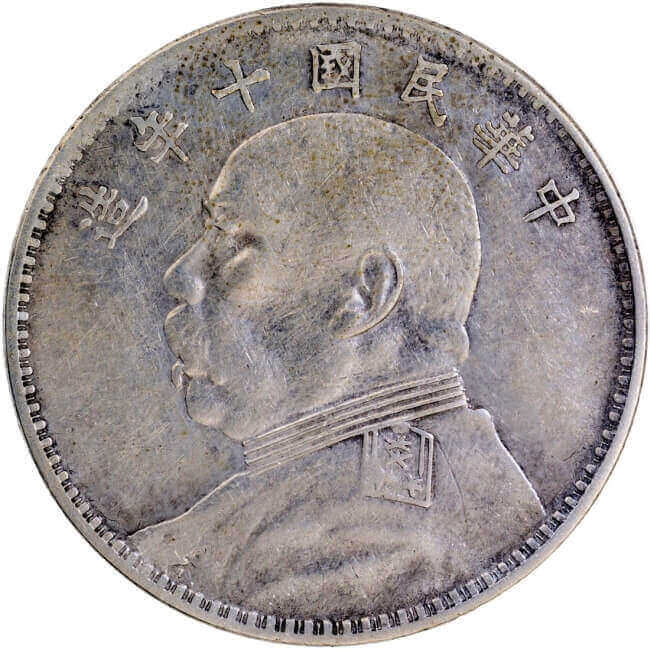
obverse side of the Yuan Shikai silver dollars
From a technical standpoint, the Yuan Shikai dollar adheres to relatively consistent specifications, although minor variations exist. The standard coin has a diameter of approximately 39 mm and a weight of about 26.4 to 26.9 grams. Its composition is typically around .890 fine silver (89% silver), giving it an actual silver weight (ASW) of roughly 0.75 – 0.77 troy ounces. The edge is reeded, and the thickness averages about 2.6 mm. These specifications are crucial for collectors, as deviations can indicate either rare varieties or, more commonly, counterfeits.
The main series of Yuan Shikai dollars is organized by “years” of the Republic of China, counted from 1912. The most common issues include:
- Year 3 (1914) – the first and most historically significant issue
- Year 8 (1919)
- Year 9 (1920)
- Year 10 (1921)
Among these, the Year 3 issue is particularly important, as it established the standard design. Notably, early Year 3 coins feature only six Chinese characters on the obverse, while later issues include a seventh character (“造”), providing an important diagnostic for collectors.
Although these are the principal dates, production extended beyond these years. Official minting continued until roughly 1928, with sporadic regional production persisting into the mid-20th century. In total, the mintage is estimated at an astonishing 1 billion coins or more, making it one of the most heavily produced silver coin types in history.
Despite this enormous output, collectors prize the series for its numerous varieties. Differences arise from mint locations, die engraving styles, and later die repairs or modifications. For example, variations can be found in the style of Yuan’s epaulets, the shape of Chinese characters, and subtle details in the wreath design. Some regional issues, such as those from Gansu province, are especially sought after due to their distinctive features and relative scarcity. Over time, worn dies were frequently re-engraved, creating an extensive range of collectible subtypes.
In terms of mintage distribution, while the overall number is vast, individual varieties can be quite scarce. The majority of surviving coins are from the more common Year 3, 9, and 10 issues, often found in circulated condition. High-grade specimens, particularly those with sharp strikes and original luster, command significant premiums in the collector market.
One critical aspect of collecting Yuan Shikai silver dollars is the prevalence of counterfeits. Due to their popularity and intrinsic silver value, these coins are among the most frequently forged in the world. Collectors, therefore, pay close attention to weight, diameter, edge reeding, and metal composition. Authentic coins typically exhibit consistent strike quality and a bright silver appearance beneath natural toning, while fakes often show irregularities in detail or incorrect metallic properties.
In conclusion, the Yuan Shikai “Fat Man” dollar occupies a unique place in numismatic history. Combining standardized specifications – 39 mm diameter, ~26.7 g weight, and .890 silver purity – with a vast mintage and an extraordinary range of varieties, it offers both accessibility and depth for collectors. Whether pursued as a type coin or as part of an advanced variety set, the series remains a cornerstone of Chinese coin collecting and a tangible link to a transformative period in China’s modern history.