Turkish Kurush Gold coins
Turkish Kurush gold coins are among the most fascinating and historically rich gold bullion and numismatic issues associated with Ottoman and Turkish monetary history. Although today the term kuruş is used as a fiat currency subunit in modern Turkey, the gold kurush coins trace their lineage to the late Ottoman Empire and have persisted through to modern commemorative and bullion issues, carrying both investment value and deep cultural heritage.
The kuruş denomination dates back to the Ottoman monetary reforms of the early 18th century and became a core unit of currency within the empire. During the transition to a modern currency system in the 19th century, the Ottoman authorities began minting gold coins in standardized kurush denominations that aligned with European currency standards while retaining distinct Ottoman artistic character.
Gold Kurush coins were widely used for trade, savings, and wealth preservation, particularly as the empire engaged with international commerce. The most enduring of these was the 100 Kurush coin, considered the backbone of Ottoman gold issues.
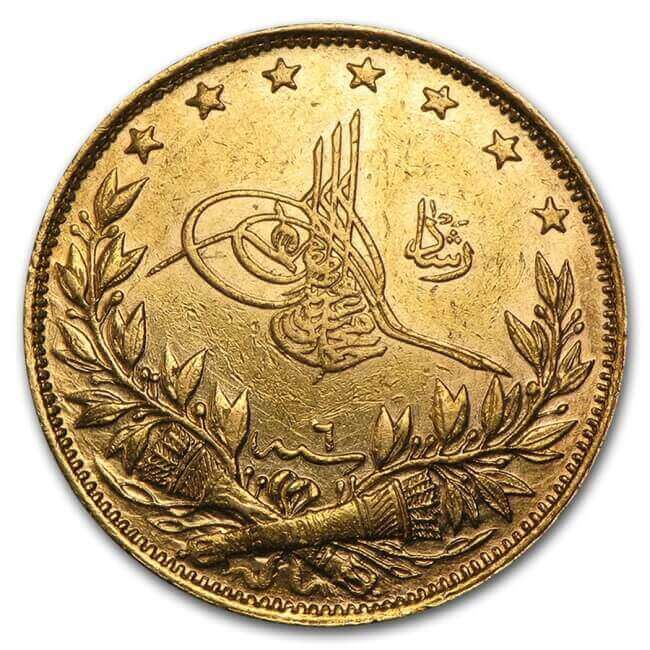
the tughra is the central design element that appears on the obverse side of Turkish Kurush gold coins
One of the most striking design elements of historic Kurush gold coins is the ‘tughra‘ – an elegant calligraphic monogram representing the reigning sultan’s name and titles. This symbol dominated the obverse of Ottoman Kurush coins and was often flanked by laurel or olive branches, stars, and other symbolic motifs.
These artistic elements were not simply decorative; they symbolized imperial authority and continuity, differentiating each issue by ruler and reign. Coins from different sultans such as Abdulmecid I, Abdulaziz, Abdulhamid II, and Mehmed V can be distinguished by variations in the tughra and accompanying symbols.
The reverse typically contained the denomination in Arabic script, enclosed by wreaths or geometric patterns, and sometimes the Islamic Hijri mint year. This blend of formal Arabic inscriptions and ornamental motifs gave the coins a distinctive aesthetic that blends Ottoman artistic traditions with influences from European coinage.
Modern Turkish bullion issues (post-1923 Republic era) often feature Mustafa Kemal Atatürk’s portrait on the obverse, with wreaths or national symbols on the reverse, reflecting the transition from imperial Ottoman motifs to modern Turkish nationalism.
One of the hallmarks of Kurush gold coins – both historic and modern bullion variants – is their gold purity. All traditional Kurush gold coins are struck in 22-carat gold, or 91.67% fine gold, an alloy that struck a balance between intrinsic value and physical durability.
This fineness was consistent across denominations, meaning that regardless of size, each coin contained gold of the same purity standard, though varying amounts of actual gold based on weight.
Kurush gold coins are available in a range of denominations, each with specific weights and physical attributes:
Historic Ottoman Kurush Gold Coins
| Denomination | Gross Weight | Fine Gold (approx) | Diameter |
| 25 Kurush | ~1.804 g | ~0.0532 oz | ~14.6 mm |
| 50 Kurush | ~3.61 g | ~0.106 oz | ~17.8 mm |
| 100 Kurush | ~7.216 g | ~0.2127 oz | ~22–22.3 mm |
| 250 Kurush | ~18.04 g | ~0.5319 oz | ~27 mm |
| 500 Kurush | ~36.08 g | ~1.0638 oz | ~34.4 mm |
These weights and dimensions show how Kurush coins roughly correspond to fractional and whole ounce bullion standards, making them attractive from both a numismatic and investment perspective.
Historic Ottoman Kurush gold coins were minted from the mid-19th century through the early 20th century, spanning multiple sultans. Mintage figures vary widely by year, denomination, and ruler, with some rare dates commanding significant premiums among collectors.
For example, the 100 Kurush issues under Sultan Abdulhamid II and Mehmed V are especially prized in higher grades due to lower survival rates and historic significance.
Modern Turkish Republic Issues
In addition to these classic coins, modern bullion Kurush gold coins continue to be minted by the Turkish State Mint, particularly smaller denominations such as 25 Kurush reflecting Atatürk’s portrait and national symbols. Their dimensions and designs are updated, but they follow the same gold purity standards as historic pieces.
From 1923 onward, Turkey continued issuing gold Kurush coins, especially in the 25 Kurush and 50 Kurush denominations, up through the late 20th and early 21st centuries. These modern issues are often cataloged as Meskuk bullion coins, with pieces produced as recent as the 2010s.
Turkish Kurush gold coins stand at the crossroads of artistry, history, and bullion investment. From the elegant tughras of the Ottoman Empire to the modern imagery of the Turkish Republic, these coins encapsulate centuries of monetary evolution. Their consistent 22-karat gold purity, range of denominations, and enduring designs make them prized by collectors and investors alike. Whether sought for their historical appeal or intrinsic gold value, Kurush gold coins remain enduring symbols of Turkey’s rich numismatic heritage.