Most Valuable Junk Silver Coins
“Junk silver” is the somewhat misleading term used by coin dealers and bullion investors for old United States coins that contain silver but have little or no collectible premium beyond their melt value. Most of these, nevertheless, somewhat valuable junk silver coins circulated heavily in everyday commerce before rising silver prices forced the U.S. Mint to abandon silver coinage in the 1960s. Today, they are valued primarily for their precious-metal content and are often referred to more respectfully as “constitutional silver.”
The majority of classic junk silver coins were struck in a 90% silver and 10% copper alloy. However, a few later issues contain only 40% or 35% silver. Investors prize these coins because they are easily recognizable, divisible into small units, and usually cheaper than modern bullion coins such as the American Silver Eagles.
Below is a ranking of the principal American junk silver coins, ordered from the highest amount of pure silver per coin down to the lowest.
| Rank | Coin Type | Years | Silver Purity | Pure Silver per Coin |
|---|---|---|---|---|
| 1 | Morgan Dollar | 1878–1921 | 90% | 24.06 g |
| 2 | Peace Dollar | 1921–1935 | 90% | 24.06 g |
| 3 | 90% Half Dollar (Walking Liberty, Franklin, 1964 Kennedy) | 1916–1964 | 90% | 11.25 g |
| 4 | 40% Kennedy Half Dollar | 1965–1970 | 40% | 4.60 g |
| 5 | Washington Quarter / Standing Liberty Quarter / Barber Quarter | Pre-1965 | 90% | 5.62 g |
| 6 | Dimes (Mercury, Roosevelt, Barber) | Pre-1965 | 90% | 2.25 g |
| 7 | War Nickel | 1942–1945 | 35% | 1.75 g |
The Morgan and Peace silver dollars stand at the top of the valuable junk silver list. These large one-dollar coins each contain approximately 0.7734 troy ounces of silver, equal to about 24.06 grams of pure silver. Because of their size, historic appeal, and strong collector demand, they often command premiums above ordinary junk silver prices. Morgan dollars, designed by George T. Morgan, were minted from 1878 to 1921, while Peace dollars commemorated the end of the First World War and were struck from 1921 to 1935.
Next come the classic 90% silver half dollars. These include the famous Walking Liberty half dollar, the Franklin half dollar, and the 1964 Kennedy half dollar. Each contains approximately 0.3617 troy ounces, or about 11.25 grams, of pure silver. The Walking Liberty design is especially admired and later inspired the modern American Silver Eagle bullion coin.
The 1965–1970 Kennedy half dollars occupy a transitional position. Following the Coinage Act of 1965, the silver content was reduced from 90% to 40%. Although these coins contain significantly less silver — roughly 4.6 grams per coin — they are still widely traded as junk silver because they remain affordable and recognizable.
Pre-1965 quarters are among the most commonly encountered junk silver coins. Washington quarters, Standing Liberty quarters, and Barber quarters all contain approximately 5.62 grams of pure silver each. At current silver prices, even a heavily worn silver quarter may be worth many times its face value.
Silver dimes are extremely popular with small-scale investors because they provide fractional silver in compact form. Mercury dimes, Roosevelt dimes, and Barber dimes minted before 1965 each contain about 2.25 grams of pure silver. Many bullion buyers like them because they are useful for small transactions and easy to store in quantity.
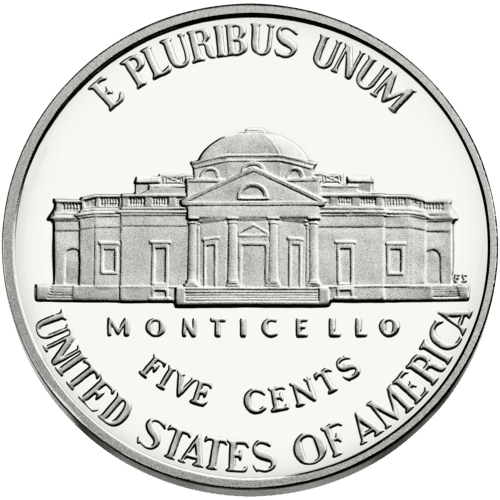
Among the various valuable junk silver coins listed on this page, the 5-Cent coins known as War Nickels contain the least silver.
At the bottom of the ranking sits the wartime silver nickel, usually called the “War Nickel.” During the Second World War, nickel metal was needed for military production, so from late 1942 through 1945, the U.S. Mint produced five-cent coins containing 35% silver instead. These coins contain only about 1.75 grams of pure silver each, but they remain a favorite entry-level collectible because they are inexpensive and historically interesting. They can usually be identified by the large mintmark above Monticello on the reverse side.
One important point for collectors is that not every old silver coin qualifies as junk silver. Rare dates, mint errors, or exceptionally well-preserved examples may possess substantial numismatic value far above their silver content. For instance, certain rare Roosevelt dimes or silver-error quarters have sold for thousands of dollars at auction.
Today, valuable junk silver coins such as the ones listed above remain popular both as a hedge against inflation and as a tangible piece of American monetary history. Rising silver prices in recent years have renewed public interest, leading many people to search through old jars of coins and inherited collections. What once circulated as ordinary pocket change can now represent a surprisingly valuable store of precious metal.