Japanese Shu Gold Coins
Among world numismatics, few coins captivate collectors like the small Japanese Shu gold coins from the late Edo period. These coins – primarily the 1 Shu (Isshu-kin) and 2 Shu (Nishu-kin) denominated gold pieces – were products of Japan’s unique trimetallic monetary system under the Tokugawa shogunate, a system that balanced gold, silver, and copper coinage to stabilize internal commerce during more than 250 years of relative peace and isolation.
Under Edo period monetary policy, currency units were hierarchical:
- 1 Ryō was the chief unit of gold currency, usually in the form of an oval Koban.
- 1 Bu equaled ¼ of a Ryō.
- 1 Shu was ¼ of a Bu, and thus 1 Shu = 1⁄16 Ryō.
Shu coins filled the gap between larger gold denominations and the everyday silver and copper coins used in regular commerce.
Their rectangular or square shapes were a distinct departure from the round coins familiar in Western and Chinese numismatics. While silver Shu issues (called gin) are more commonly encountered, the gold Shu coins occupy a special niche because of their rarity, metallurgy, and historic role as subsidiary gold currency.
The 1 Shu Gold Coin (Isshu-kin)
The first gold 1 Shu coins were introduced in May 1824 (late Bunsei era) as part of a broader effort to supplement Japan’s gold and silver denominations. They were meant to serve as subsidiary gold currency, facilitating smaller transactions than the traditional Koban and Ichibuban coins.
The original Bunsei-era Isshu-kin was struck with a low gold content – approximately 12.3 % gold, with the balance predominantly silver and trace metals. This alloy produced a paler, less lustrous surface that often wore rapidly in circulation, exposing the silver beneath and causing it to darken with use.
- Weight: ~1.40 g
- Composition: ~12.3 % gold (Au), ~87.4 % silver (Ag), 0.3 % other metals
- Shape: Square/rectangular irregular
- Years Minted: ~1824–1832
- Demonetized: Legally discontinued in 1840 as silver replacements were phased in due to public dissatisfaction.
The obverse typically bears the Paulownia crest (kiri mon), an emblem associated with Japanese governance and often used on Edo-era coinage, along with Chinese characters for the denomination. The reverse usually carries signatures or marks of mint officials, sometimes in fine calligraphic script, and may include dotted or beaded borders that serve both decorative and anti-counterfeiting purposes.
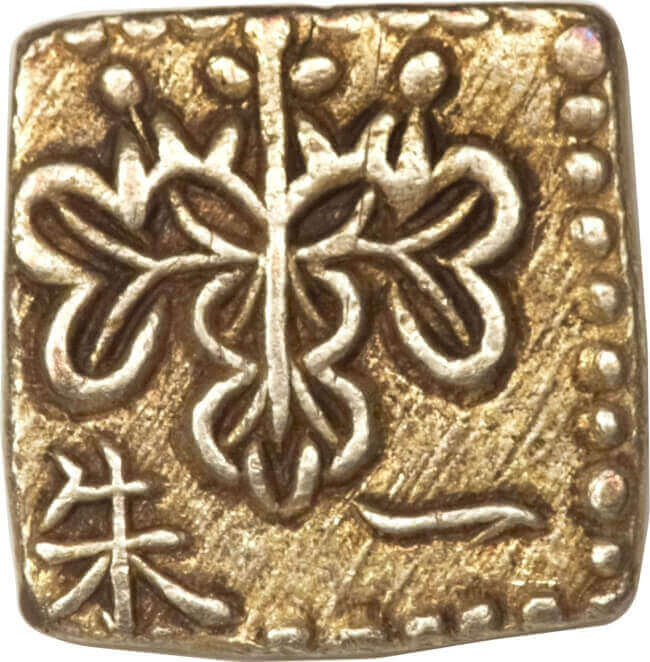
The Paulownia crest can be seen at the top of the obverse side of Japanese Shu gold coins, like this 1 Shu gold coin
For collectors, the Bunsei 1 Shu is notable not only for its unusual alloy but also because its limited period of production and relatively low survivorship make quality examples scarce on the market. Its small size and low gold content mean most value derives from numismatic interest and historical context rather than bullion weight.
The 2 Shu Gold Coin (Nishu-kin)
The 2 Shu gold coin has a slightly more complex history. Although the very first 2 Shu pieces date back to 1697 (Genroku era), those early issues were more akin in purity and format to larger gold coins and are often classified with the Oban family.
For most collectors, the relevant series begins with the Tenpō Nishu-kin, minted from 1832 and circulating until 1858 – a much longer run than the 1 Shu gold coin.
Later 2 Shu coins shifted toward a higher gold percentage than their 1 Shu counterparts, though they were still heavily alloyed with silver:
- Weight: ~1.64 g
- Composition: ~29.8 – 29.9 % gold, ~69.7 % silver, trace misc.
- Dimensions: ~13 mm × 7.5 mm (rectangular, irregular)
- Years Minted: 1832 – 1858
- Alloy Notes: Some later Man’en era (1860 – 1869) pieces show slightly reduced gold content (~22.9 % Au) and lighter weights when compared to earlier Tenpō issues.
These alloy proportions mean that, strictly by bullion content, these coins are closer to electrum (a gold-silver alloy) than pure gold. They should be evaluated accordingly when calculating intrinsic value.
The obverse of Tenpō Nishu-kin frequently displays the Paulownia crest above Chinese characters for “2 Shu” (二朱), often within a dotted border. The reverse carries mint official names (e.g., Mitsutsugu) in grass script, also surrounded by a dotted border. These hand-engraved inscriptions give each coin a unique character that modern collectors admire.
Coins of this type were produced at the Kinza Mint in Edo (modern Tokyo), under strict supervision to ensure uniformity in weight and design – a requirement in the Tokugawa monetary system, where coin values depended more on weight and alloy than purely on inscriptions.
Mintage Figures of Japanese Shu Gold Coins
Precise official mintage records for Shu gold coins are rare or fragmentary. However, modern numismatic catalogues suggest mintage figures on the order of ~100,000 + for some 2 Shu types, though survivors in collectible condition are scarcer due to circulation wear and age.
Because they remained in circulation for decades, many examples show significant wear, and high-grade pieces – especially those certified with quality grades from PCGS or similar – are prized. Some graded issues are noted as rare in certification censuses, making them excellent key pieces for advanced Japanese coin collections.
Given their age and circulation, many Shu gold coins show wear, toning, and alloy-induced color variation. Early 1 Shu pieces can lose surface gold coloring entirely, leaving darker silver hues, which affect both eye appeal and market value.
Certified coins (especially high grades like PCGS MS or VF35 examples) command premiums, particularly for 2 Shu, where attractive strikes and good detail are less common.
These coins tell a story of monetary change in Japan: from reliance on the large gold koban to the introduction of fractional gold denominations intended to smooth commerce across a growing domestic economy. Their existence reflects Edo-period responses to counterfeiting, economic stresses, and the difficulties of balancing a tri-metallic coinage system before the adoption of the westernized yen in the 1870s.
The 1 Shu and 2 Shu gold coins of the Edo period occupy a special place in Japanese numismatics. Though small in size and alloyed with silver, they encapsulate significant economic, artistic, and governmental threads of Tokugawa Japan. For collectors, Japanese Shu gold coins offer both historical depth and collectible rarity, making them compelling additions to collections focused on Asian, gold, or world fractional coinage. Careful attention to weight, composition, dimensions, and mint marks will help distinguish genuine historical examples from later replicas or altered pieces – a rewarding challenge for every serious enthusiast.