The Afghanistan Gold Amani Coins
Among early 20th-century Islamic gold coinages, few series are as historically significant and elusive as the Afghanistan Gold Amani coins. Issued during the reign of King Amanullah Khan (1919–1929), these coins were struck for only a brief period and in a very limited range of denominations. Their short production life, incomplete mint records, and distinctive Islamic design make them particularly appealing to advanced world-coin collectors.
Afghanistan emerged as a fully independent nation following the Third Anglo-Afghan War in 1919. King Amanullah Khan sought to modernize the country rapidly, introducing political, social, and economic reforms. One of his priorities was establishing a modern national currency system that could stand alongside those of other sovereign states.
The gold Amani coins were part of this effort. Named after the king himself, the Amani functioned as both a prestige gold coinage and a monetary anchor during a transitional period when older systems based on rupees and regional silver coinage were still in use. The coins were struck only during the 1920s, and their issuance appears to have ended abruptly with the political instability that culminated in Amanullah’s abdication in 1929.
Modern numismatic research and market evidence confirm four official gold Amani denominations. No contemporary mint documentation survives, but auction records, museum holdings, and specialist catalogs consistently support this structure.
- ½ Amani (Half Amani) – This smallest gold denomination is among the rarest. Struck in .900 fine gold, it weighs approximately 3 grams and measures about 18 mm. The half Amani was likely intended for ceremonial or savings purposes rather than daily commerce. Few examples appear in auctions, and high-grade pieces command strong premiums relative to their gold content.
- 1 Amani – The 1 Amani is considered the “standard” gold unit of the series. It contains roughly 6 grams of .900 gold and has a diameter of approximately 23 mm. Although more available than the half Amani, it is still scarce by global standards. Collectors often encounter examples dated to the mid-1920s, typically preserved in lightly circulated or mint-state condition.
- 2 Amani – The 2 Amani is the most frequently encountered denomination of the series. Weighing about 9.2 grams of .900 fine gold, it appears to have been struck across several years and may have served as the primary high-value circulating gold coin. Even so, it remains scarce compared to European or Middle Eastern gold coins of the same era.
- 5 Amani – The largest and most impressive denomination, the 5 Amani, is a substantial gold coin weighing roughly 23 grams. It was struck only briefly and in very small numbers. Surviving examples are rare and highly sought after, particularly in mint state. For many collectors, the 5 Amani represents the pinnacle of the Afghan gold series.
The Amani coins are notable for their purely Islamic design, with no portrait of the ruler, just like the Turkish Kurush gold coins, for example. Instead, the obverse typically features an elegant tughra-style calligraphic inscription bearing Amanullah Khan’s name and titles. The reverse includes the denomination and date in Arabic script, sometimes framed by decorative elements or symbolic architecture associated with Afghan sovereignty. This restrained and dignified aesthetic appeals strongly to collectors of Islamic and Central Asian coinage.
One of the defining characteristics of the Amani series is the absence of official mintage figures. Scholars estimate that total production across all denominations was small, and survival rates are lower still. Many examples appear well preserved, suggesting that a significant portion of the coinage was hoarded or stored rather than heavily circulated.
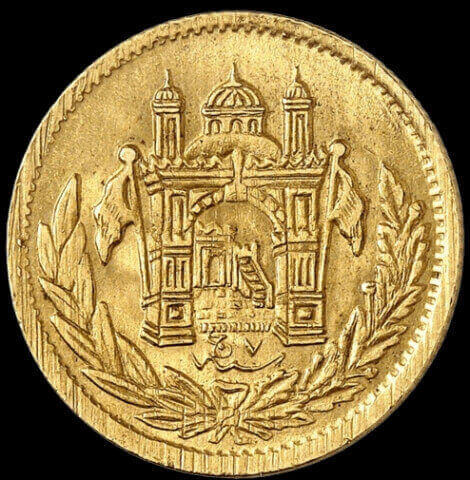
The Islamic influences in the design of the Afghanistan Gold Amani coins can be clearly seen, just like on this 1 Gold Amani coin
Today, Afghanistan Gold Amani coins surface only sporadically in major auctions. When they do, competition is strong, particularly for the half and 5 Amani denominations. Prices are driven more by rarity and historical importance than by bullion value alone.
The Afghanistan Gold Amani coins represent a fleeting moment when a newly independent nation sought to define itself through gold coinage. Their brief issuance, limited denominations, and political backdrop give them a mystique that few modern gold series can match. For collectors interested in rarity, Islamic artistry, and historical depth, the Amani coins remain one of the most compelling — and challenging — pursuits in world numismatics.