Swedish Kronor Gold Coins
The Swedish Kronor gold coins of the late nineteenth and early twentieth centuries are among the most attractive and historically important European gold issues. Struck under the framework of the Scandinavian Monetary Union, these coins circulated alongside similar gold pieces issued by Denmark and Norway. Their standardized specifications allowed them to circulate freely throughout the union, making them the Scandinavian equivalent of the better-known Latin Monetary Union gold coins.
The Scandinavian Monetary Union was established in 1873 and adopted the gold standard. Member countries based their currencies on the krona (or krone), with gold coins struck to uniform standards. Sweden issued both 10-kronor and 20-kronor gold pieces, each containing .900 fine gold (90% purity), the same fineness used by many contemporary European gold coins.
Swedish 10-Kronor Gold Coins
The Swedish 10-kronor gold coins were first issued in 1873 and remained in production, with interruptions, until the early twentieth century. The coins weigh 4.4803 grams, contain approximately 4.03 grams of pure gold, and measure 18 millimeters in diameter. Their edge is reeded.
The obverse depicts King Oscar II facing right. Early issues bear the inscription “OSCAR II SVERIGES O. NORGES KONUNG” (“Oscar II, King of Sweden and Norway”), while later issues spell out “OCH” instead of the abbreviated “O.” The engraver’s initials, “L.A.”, refer to the celebrated Swedish engraver Lea Ahlborn, one of the first prominent female mint engravers in Europe.
The reverse features the crowned royal coat of arms within an ornate mantle. Above appears the royal motto “BRÖDRAFOLKENS VÄL” (“For the welfare of the brother peoples”), referring to the union between Sweden and Norway. The denomination “10 KRONOR” appears below, accompanied by the mintmaster’s initials, such as “E.B.” for Emil Brusewitz.
Collectors pay particular attention to the various dates and inscription varieties. Notable mintages include:
| Year | Approximate Mintage |
|---|---|
| 1876 | 67,600 |
| 1877 | 55,023 |
| 1880 | 26,553 |
| 1883 | 148,917 |
| 1894 | 36,020 |
| 1895 | 65,352 |
| 1901 | 213,286 |
Some dates, especially 1880 and certain inscription variants, are considerably scarcer than common bullion examples. Total production of Oscar II’s 10-kronor gold coins exceeded 1.17 million pieces.
Swedish 20-Kronor Gold Coins
The 20-kronor gold coin was the larger and more widely collected denomination. It followed the same monetary standard but doubled the gold content. The coin weighs approximately 8.96 grams, contains about 8.06 grams of pure gold, is struck in .900 fine gold, and measures roughly 23 millimeters in diameter. Like the 10-kronor piece, it features a reeded edge.
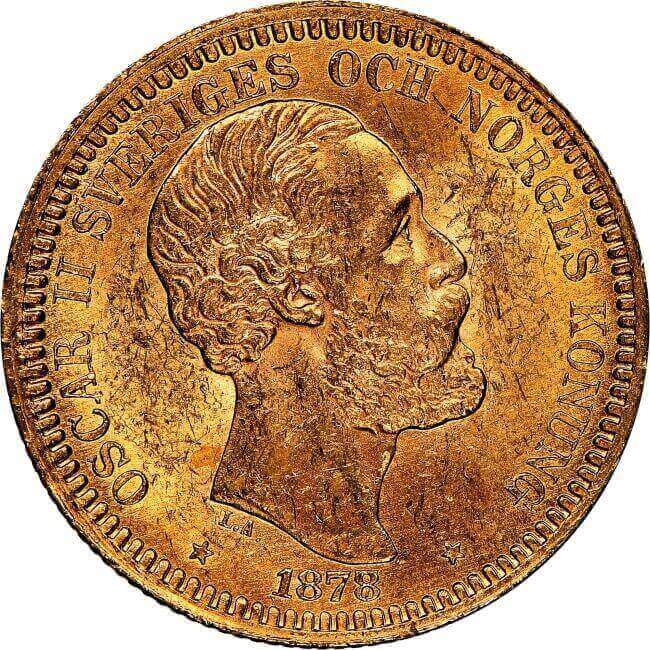
The portrait of King Oscar II appears on the obverse of most 10 and 20 Swedish Kronor gold coins
The design closely mirrors that of the 10-kronor piece. The obverse bears the portrait of the reigning monarch, most commonly Oscar II and later Gustaf V. The reverse displays the crowned Swedish royal arms and the denomination “20 KRONOR” beneath the union motto “BRÖDRAFOLKENS VÄL.” This consistent design language gave Swedish gold coinage a distinctive and dignified appearance that remains popular with collectors today.
The 20-kronor series was struck in substantially larger numbers than many 10-kronor dates. Common Oscar II issues and later Gustaf V issues survive in significant quantities, partly because many were preserved as savings or bullion coins rather than spent in circulation. As a result, collectors can often find attractive Mint State examples at premiums only modestly above their intrinsic gold value.
Collectability and Modern Appeal
Today, Swedish Scandinavian Union gold coins appeal to both numismatists and bullion investors. Collectors appreciate the historical connection between Sweden, Norway, and Denmark, the elegant nineteenth-century engraving, and the numerous date and inscription varieties. Investors value the coins for their recognized gold content and relatively low premiums compared with many modern bullion issues.
Particularly desirable pieces include scarce early dates, high-grade certified examples, and coins with unusual inscription varieties. Superb Mint State examples graded by major services such as NGC or PCGS can command substantial premiums over melt value, especially when preserved with original mint luster.
More than a century after the dissolution of the Scandinavian Monetary Union, Swedish Kronor gold coins remain enduring symbols of a remarkable experiment in international monetary cooperation and rank among the most beautiful historic gold coins of northern Europe.