German Goldmark Coins
The gold-based currency known as the German Goldmark formed the monetary backbone of the German Empire from 1873 until the outbreak of the First World War in 1914. Introduced following the unification of Germany under Prussian leadership, the German Goldmark coins replaced a patchwork of regional currencies and established a uniform system tied directly to gold. This reform created not only a stable monetary system but also a remarkable series of gold coins—especially the 5, 10, and 20 Mark pieces—that remain highly prized among collectors and bullion investors today.
Historical Background and Monetary Standard
The Goldmark was defined by a strict gold standard: one Mark corresponded to approximately 0.358 grams of pure gold. This placed the currency within the broader framework of late 19th-century international gold-based monetary systems. Gold coins were minted to a standard of 2,790 Marks per kilogram of gold, ensuring consistency across denominations and issuing states.
Although the German Empire was politically unified, coin production remained decentralized. Various kingdoms and duchies—such as Prussia, Bavaria, Saxony, and Württemberg—issued their own designs, typically featuring the portrait of the ruling monarch on the obverse and the imperial eagle on the reverse. This diversity of designs adds a rich numismatic dimension to the series, with collectors often specializing in specific states or rulers.
General Specifications of the German Goldmark Coins
All German Goldmark coins were struck in .900 fine gold (90% gold, 10% copper), a durable alloy that improved resistance to wear while maintaining intrinsic value. The coins’ standardized gold content made them reliable both as circulating currency and as stores of value—an attribute that continues to appeal to modern bullion investors.
The 5 Mark Gold Coin
The 5 Mark gold coin is by far the rarest of the three denominations. It was minted only briefly, in 1877 and 1878, making it a key date issue for collectors.
- Weight: 1.9912 grams
- Pure gold content: 1.7921 grams
- Diameter: approx. 16 mm
Due to its short production run and limited mintage, the 5 Mark gold coin is seldom encountered on the market. Unlike the more common 10 and 20 Mark pieces, it commands a significant numismatic premium that often far exceeds its bullion value. For collectors, it represents a challenging and prestigious addition to a German Empire type set.
The 10 Mark Gold Coin
The 10 Mark coin occupies a middle ground between rarity and affordability, making it especially attractive to both collectors and investors. It was minted continuously from the early 1870s until 1914 and exists in a wide variety of types reflecting different German states and rulers.
- Weight: 3.9825 grams
- Pure gold content: 3.584 grams (approx. 0.115 troy oz)
- Diameter: 19–19.5 mm
- Thickness: about 0.9 mm
The obverse typically features a right-facing portrait of the issuing monarch, such as Kaiser Wilhelm I or Wilhelm II, while the reverse displays the imperial eagle with denomination and date.
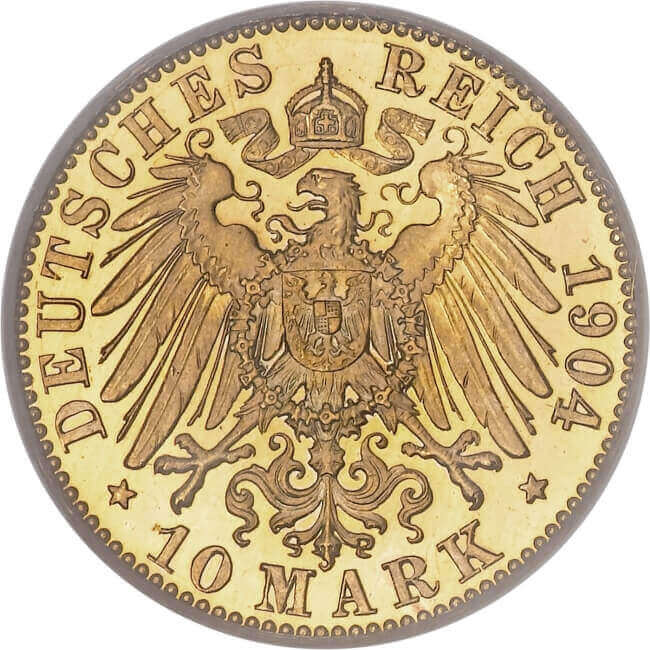
German imperial eagle on the reverse of this 10 German Goldmark coin from 1904
For bullion investors, the 10 Mark coin offers a relatively low entry point into historic gold, combining recognizable gold content with modest premiums. For collectors, its wide range of designs and mint marks provides ample opportunity for specialization.
The 20 Mark Gold Coin
The 20 Mark coin is the most iconic and widely available denomination of the German Goldmark series. It was produced in large quantities across multiple states and years, making it the most accessible option for both collectors and investors.
- Weight: 7.965 grams
- Pure gold content: 7.168 grams (approx. 0.230 troy oz)
- Diameter: approx. 22–22.5 mm
Because of its higher gold content, the 20 Mark coin is particularly popular among bullion buyers. It often trades at relatively low premiums over its melt value compared to other historic European gold coins, such as British Gold Sovereigns or French 20 Franc pieces.
From a collector’s perspective, the 20 Mark series is extraordinarily rich. While many issues are common, certain coins—especially those from smaller German states or with low mintages—are rare and can command substantial premiums. Some issues are known with mintages in the low thousands or even hundreds, making them highly desirable numismatic treasures.
Investment and Collecting Appeal
German Goldmark coins occupy a unique position at the intersection of numismatics and bullion investment. Their standardized gold content ensures intrinsic value, while their historical context—linked to the rise of the German Empire—adds cultural and collectible appeal.
For bullion investors, the 10 and especially the 20 Mark coins are attractive due to their liquidity, recognizable specifications, and relatively low premiums. Their gold content is clearly defined, making them easy to value based on current gold prices.
For collectors, the appeal lies in the diversity of designs, mint marks, and issuing states. Building a complete set—whether by denomination, ruler, or region—offers both a challenge and a rewarding exploration of German imperial history.
Conclusion
The 5, 10, and 20 Mark gold coins of the German Empire represent far more than mere currency. They are artifacts of a transformative period in European history, combining precise gold standards with artistic and political expression. Whether valued for their gold content or their numismatic significance, these coins continue to captivate enthusiasts more than a century after their last minting in 1914.